EN
EN  EN
EN DA
DA NL
NL FI
FI FR
FR DE
DE IT
IT JA
JA KO
KO NO
NO PL
PL PT
PT RO
RO RU
RU ES
ES SV
SV TL
TL ID
ID SK
SK UK
UK VI
VI TH
TH TR
TR FA
FA BE
BE LA
LA UZ
UZ
The quality of the silicon carbide (SiC) wafer produced is influenced by even subtle changes in the growth environment. An area that many don't consider is the graphite lining the reactor. It stands the test of the intense heat found inside the reactor while it supports and positions the wafer during epitaxy. If the graphite is impure or structured irregularly small bits of material or an unwanted reaction can be deposited throughout the growth process. Small problems on the graphites surface can bloom into major wafer defects, resulting in more work and lower yields for chip manufacturers. Thus the condition and cleanliness of the Grafiidisusseptor is a more important issue than most would assume.

How Graphite Purity Influences Particle Issues in Epitaxy Chambers?
Particles are a pervasive wafer defect in SiC epitaxy chambers, and frequently involve graphite in the process. The graphite parts reside in the hot zone of the SiC reactor, carrying the wafer and influencing the thermal contours. With the usage of less pure graphite, trace impurities, such as metallic contaminants, ash, or process residual residues, can outgas from the graphite slowly over time during high temperature growth. The offgassed impurities are often undetectable in the chamber, but they eventually land on the wafer surface, or become part of the gas phase.For instance, in one application a fab opted for a lower grade graphite for cost savings. Although no issues were apparent during short runs initially, after several cycles of Sic epitaksiat , random pinholes and rough spots were observed on the wafer surface. The source of such defects was traced to micro particles emitted from graphite holder or susceptor. The particles would enter the growth chamber and act as seeds in an undesirable fashion.Uneven density of the graphite part would also contribute to micro-cracking on the part surface upon heating, leading to the shedding of fine particles into the chamber over time, even though the part may appear clean.Thus, monitoring the source of graphite and its history is a routine task in fabs to avoid particle-related defects. A high purity graphite with a controlled amount of ash is generally desirable, especially for long term productions. A count of thermal cycles of parts is also monitored as materials will shed particles even after good initial processings.Also, the maintenance method for graphite parts influences defects. For example, aggressive cleaning procedures would damage graphite surface and result in micro-cracks. The preferred method is a mild, controlled cleaning process with minimal physical interaction with the graphite parts. For economic reasons, substituting the parts sooner than expected might be better than dealing with yield loss at later stages.In a nutshell, the control of particle generation in a typical SiC epitaxy process revolves around small details on material quality and handling practices. The issue of graphite quality is at the heart of the matter.

Material Requirements for High-End SiC Epitaxial Parts and Susceptors
For SiC epitaxy, the parts in the reactor are more than just to 'hold' the wafer. Susceptors, graphite carriers and hotzone components in the reactor directly influence crystal growth. This is why the materials are very demanding and a small flaw will eventually manifest as a defect on the wafer.High thermal stability is a fundamental requirement. The parts are heated to very high temperatures for a long time (sometimes repetitive heating/cooling cycles). A material that cannot maintain stability at these temperatures will distort and may eventually crack. Slight changes in geometry can significantly change gas flow and heat distribution resulting in non-uniform crystal growth on the wafer surface.Purity is another critical factor. High-end SiC processes require very low metal content and very low ash level in graphite based components. During operation the trace metals will leach slowly out of the parts, the contaminants can diffuse into the chamber and result in particle contamination or local crystal defects. In some fabs, random stacking fault has been traced to a single batch of contaminated susceptor.Surface structure is an important requirement. A smooth and even surface will help reduce the shedding of particles during the heating/cooling cycle. A non-uniform surface, or pores within the surface structure, will continuously break down during operation and thus generate a steady source of particles into the chamber.Quality of coating is also another essential requirement. Many high-end susceptors use SiC coating as a protection layer. The coating must adhere well to the base material and must withstand prolonged operation. Poor bonding and de-lamination will directly expose the base graphite to the harsh reaction environment.We often see this in real applications: for instance, a wafer fab running for long production batch will observe the defect rate goes up steadily after hundreds cycles. Inspecting the susceptor will reveal a slight wear of the coating and edge erosion. Changing or replacing the component will return the defect rate to an acceptable level.Choosing the right materials is not just about the initial performance of the components, but the stability of the material in repeated cycles.
Grain Structure Effects on Thermal Stability in AIXTRON G10 Systems
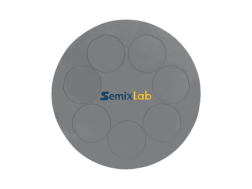
The grain structure of graphite components inside a high-temperature SiC Epitaksiaalne kasv system, such as an AIXTRON G10, greatly impacts thermal stability. This relates to dimensional changes, shape retention, and response to thermal cycling.Graphite isn't a monolithic solid. It consists of numerous crystallites or grains. The individual crystallites might have different orientations. When there is poor control of grain size within the graphite component, uneven heat distribution arises. Areas of the component heat up and cool down at different rates. This creates internal stress on a micro level. Slowly over time this internal stress causes warp or distortion in parts like the susceptor or the wafer carrier.This process is easily identifiable during production. It typically appears when the wafer line is operating at high temperatures. The wafer quality starts to drift after hundreds of thermal cycles. Variations in thickness increase, and edge defects begin to emerge more regularly. Once these parts are examined they usually have signs of warping or material fatigue.Fine grain structures with controlled crystallite distribution will have much better thermal stability than coarse grains or random structures. This will result in more even heat transfer and reduced localized stress points. With a proper grain structure the parts will resist warp even over hundreds of thermal cycles. Coarse structures or poorly distributed grain structures result in weak spots within the part, allowing microcracking and eventual release of particles into the chamber.Another key issue to consider is resistance to thermal shock. There are points where the part undergoes significant temperature change such as loading into the reactor or upon removal. If there are weak boundaries between grains then micro-cracks may form along the grain lines. While this does not typically result in part failure, it allows these weaknesses to form in the material, leading to future reliability issues.Most fabs track part lifetime both by the hours used, and the number of thermal cycles and total heat treatment. The parts with well-engineered grain structure have longer life, more consistent results over time.
Reducing Metallic Contamination in High-Purity Graphite Components
One of the "unseen" but critical problems in any graphite part, including in SiC epitaxy process, is the metallic contamination. Even minute traces of metals in a graphite part can leach into the process and become a source of difficult to trace defects in a SiC epitaxy reactor like the AIXTRON G10.Such metals are normally originating from the raw materials or the various processing steps involved in the manufacture of the graphite component. Elements like Iron, Nickel, Calcium and Sodium are common and remain trapped in the bulk of the graphite at room temperature, however, at the elevated process temperature used in SiC epitaxy, these elements might become mobile. These trace metals can eventually be outgassed or migrate onto the surface during repeated heating/cooling cycles in the hot zone, namely the susceptor or the wafer carrier itself.A typical case would be like this: a fab starts a production batch using new graphite parts. The first few wafers are ok and exhibit no defects, but after a certain period, small defects start to appear. They are usually tiny pits,random stack faults, or unexplainable particle events. It is easy to wrongly suspect a wrong gas flow or a contamination event during the chamber cleaning. But detailed analysis often leads back to the slow release of trace metals from graphite components.Controlling the purity of graphite is one of the keys. For critical components, high temperature purified graphite with a low ash content is always preferred. This purification step removes the majority of metallic residue. Such graphite can keep the elements trapped for a longer time even under repeated heating/cooling cycles.The incoming inspection of graphite parts is also very important in some fabs. Testing the graphite batches with techniques such as ICP-OES or XRF can prevent using contaminated parts. It may also prevent mixing parts from different sources within the same process flow.Coatings such as SiC or TaC also help to solve the problem by acting as a barrier between the graphite part and the process environment. As long as the coating is well deposited and bonded to the underlying graphite substrate it will reduce the graphite part interaction with the process environment.Last but not least is the handling and storage of the graphite parts. Graphite parts can be contaminated during handling with dirty gloves, instruments or by being stored on an unclean shelf. This surface contamination can then get into the furnace during the heating cycle.To reduce metallic contamination of graphite parts, it is a sum of many small efforts. A high purity material combined with good handling practice and tight process control is required.
Why Veeco EPIK Systems Demand Ultra-Low Porosity Graphite Materials?
Graphite parts within the Veeco EPIK Systems platform undergo one of the harshest process conditions in semiconductor manufacturing. Conditions of high temperature, aggressive gas chemistry and long process cycles are experienced by these components. Ultra low porosity graphite is thus critical to maintain SiC epitaxy integrity and cleanness.Porosity refers to the small, internal pores that exist within the graphite body itself. Despite a perfectly smooth surface, internal pores can exist trapping process gasses, residues and cleaning chemistry. High porosity means more internal volume for trapping, where after high temperature exposure, material can be slowly degassed. This degassing is not always linear and may lead to bursts, making the process difficult to control.In SiC epitaxy, this is especially detrimental. When gases are released from the graphite body they can be incorporated into the gas flow within the epitaxy chamber, contributing to unwanted particles. Particles will find their way onto the wafer surface, impacting on crystal growth and can lead to unexpected defects such as random pits, surface roughing or local variations in wafer thickness.A typical scenario encountered is in production ramps where a clean fab receives new graphite parts for an EPIK system. Initial results might be acceptable, however as the thermal cycles repeat, the defect rates may creep up and inspection of the process train including gas lines, valves and cleaning process stages might reveal nothing obvious. Often it is revealed that the culprit is the low-porosity graphite within the high temperature zone.The selection of ultra low porosity graphite effectively minimizes this risk by limiting the internal volumes in which trapped species can be hidden, minimizing the likelihood of sudden gas releases when heated. It is also associated with better mechanical integrity. The denser structure of ultra low porosity graphite typically offers increased resistance to cracking as the graphite undergoes repeated thermal cycling.Furthermore, low porosity surfaces promote enhanced coating integrity. When SiC or other refractory materials are coated onto these graphite surfaces, they adhere well to a less porous surface. This is likely due to increased intimacy of the bonding between the coated material and the graphite, which in turn enhances the durability and longevity of the coatings and their potential to peel or flake.Ultimately, the selection of ultra low porosity graphite in a day-to-day fabrication scenario, while a material property, provides very direct benefit in achieving stable, clean, predictable wafer results within high-end SiC epitaxy processes.
Sisukord
- How Graphite Purity Influences Particle Issues in Epitaxy Chambers?
- Material Requirements for High-End SiC Epitaxial Parts and Susceptors
- Grain Structure Effects on Thermal Stability in AIXTRON G10 Systems
- Reducing Metallic Contamination in High-Purity Graphite Components
- Why Veeco EPIK Systems Demand Ultra-Low Porosity Graphite Materials?
Semixlab Technology Co., Ltd, mis asutati 2018. aastal, on tehnoloogiapõhine ettevõte, mis keskendub täiustatud materjalide uurimis- ja arendustegevusele, tootmisele ja müügile. See on maailma juhtiv pooljuhtmaterjalide tootja.